Art and Christianity

Songwriter Andrew Peterson once attended a class where the instructor asked everyone to call out adjectives to describe Christian art. The group said words like “mediocre,” “cheesy,” “shallow,” “trite,” “saccharine,” and “derivative.”
The instructor wrote their words on the board. Then, he asked his students to bring to mind Christian artists such as J.S. Bach, Rembrandt, and Carravagio. Did the adjectives still fit?
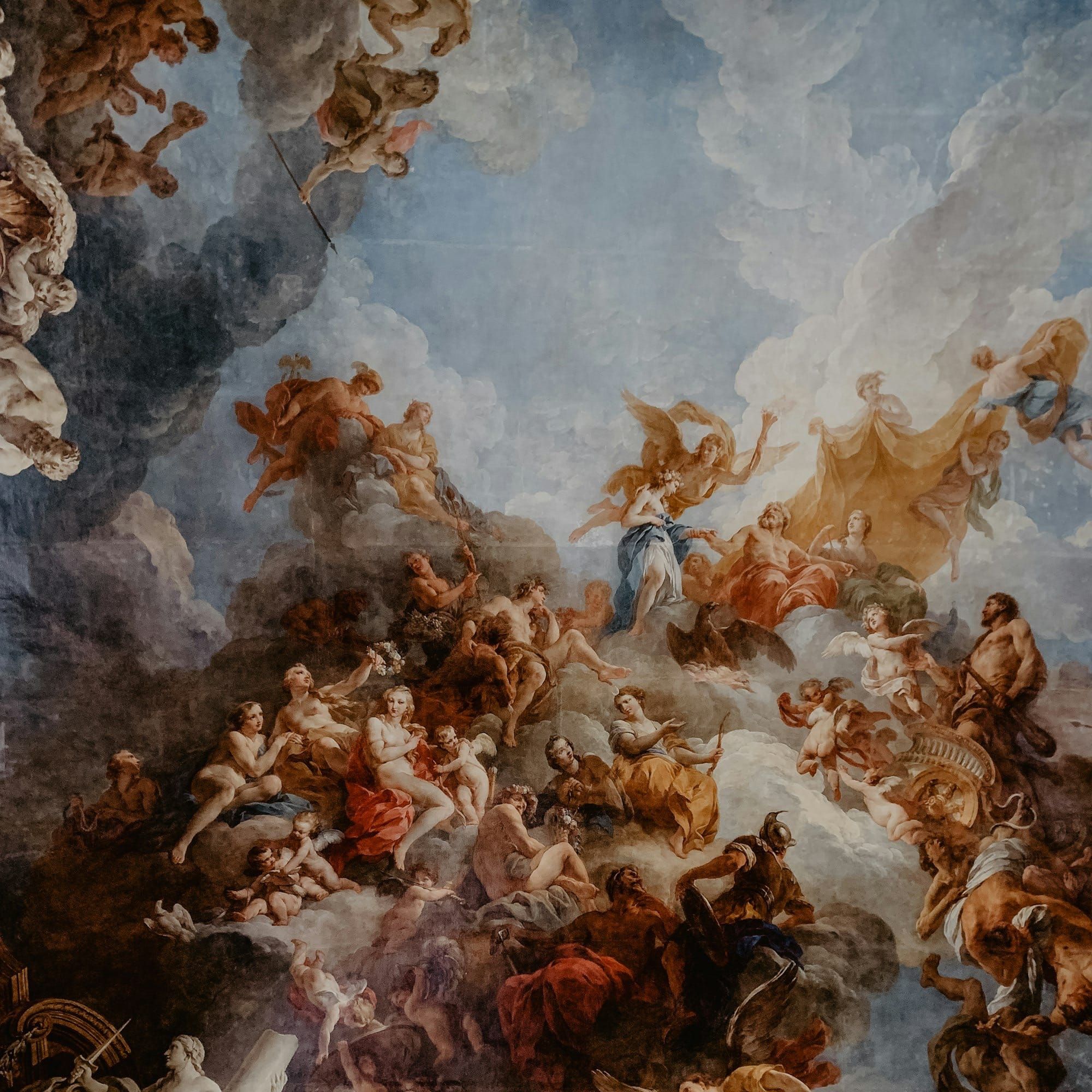
For several hundred years starting in at least the 15th century, the world’s most celebrated artists found their theme in Christianity. From Michelangelo in the 1500’s to Rembrandt in the 1600’s to Bach in the 1700’s, the biggest names in art were sculpting, painting, and composing works like David, The Return of the Prodigal Son, and St Matthew Passion.
In the last century, however, many of our biggest artists and their works have rarely made mention of Christ (e.g. The Beatles, Jackson Pollock, etc.).
What changed over the last 500 years? Was all the world’s creative talent concentrated in Christians in the middle of the millennium, and now in modern times is all concentrated in non-Christians?
More likely, the shift in artistic inspiration reflects a broader shift of religious influence in Western Culture.
While Christianity is far from being a religious minority in the United States—roughly 62% of U.S. adults identified as Christian from 2023-24—its majority share has shrunk significantly since the turn of the century. This does not mean God is dying or the Christian faith is going to collapse, but it does mean its religious expression is changing.
People living during The Renaissance, for example, were surrounded by a culture, government, and social life saturated in Christianity. Several of the artists first mentioned were, at least in part, financially supported by the Church.
People living now, particularly in the West, have become increasingly agnostic, atheistic, or simply unsure about God. The cultural landscape has changed, and it follows that art would reflect the culture.
Whereas artistic giants of times past publicly worshiped God, most greats of today have little to say about him. This leaves modern Christian artists caught in a muddy middle ground. They are no longer creating for a generation that wholeheartedly embraces Christianity, but neither are they speaking to a world that is entirely post-Christian.
How does such an artist speak to their generation in such an ambiguous time? Should they still write about God, paint biblical scenes, or sing about Jesus?
On the one hand, absolutely yes. The success of a show like The Chosen validates the need to tell Christ’s story through new mediums and in fresh ways. Works of art that bring Jesus’ story to life are as important as ever.
That said, they are not the sole ways an artist can make God’s beauty evident to our world, and they are not the only types of art that help reveal the Kingdom of God.
Western society has been steeped in Christian ideas for so long, many of us have developed an overfamiliarity with what we think is the God story. Well intentioned people have framed the gospel with so many should’s, shall’s, ought’s, and heavy obligations that, for many, awe and mystery have been drained from the biblical narrative.
Especially amidst modern apprehension about Christianity, less observably ‘Christian’ forms of art may inspire in us a sense of wonder that easily shuts down whenever we hear another rendition of the “old, old story,” as the hymn goes.
If we limit our definition of the Christian artist to only those who write, sing, sculpt, photograph, film, dance, compose, or paint explicitly biblical content, we risk missing out on all the ways Christ can be made incarnate to a society who increasingly misunderstands him.
Take a handful of examples from 20th century literature:
The Lord of the Rings by J.R.R. Tolkien, The Chronicles of Narnia by C.S. Lewis, A Wrinkle in Time by Madeline L’Engle, Bridge to Terabithia by Katherine Paterson, or Pilgrim at Tinker Creek by Annie Dillard.
While some are more overtly Christian in content or theme than others, all are pieces of art that leave their readers with an impression—the idea that despite deep evil, sickness, and brokenness all around, there is still beauty, grace, and goodness present beyond our imaginations.
Wrapped up in fairy tales and other lives, the reader gets to forget, even if for a moment, the walls that guard their heart. And maybe they get to believe, even if for a moment, that hope is not lost.
In his essay Sometimes Fairy Stories May Say Best What's to be Said, C.S. Lewis recounts the inhibition he had toward God since childhood. Though he was told he should feel certain ways about God, he had the hardest time conjuring up such feelings.
The primary reason he cites for his struggle to feel properly was chiefly because he was told he ought to. “An obligation to feel can freeze feelings.”
Once an adult and eventually a Christian, Lewis would write extensively about God—first through non-fiction works and eventually through children’s stories.
Through the stories, he wanted to put what he had to say about love and truth into an imaginary world, stripped of their “stained-glass and Sunday school associations.” This way, he could try to “make them for the first time appear in their real potency,” and “steal past those watchful dragons [inhibitions].”
In doing so, Lewis led readers into fantastical universes where evil is present but help is on the way, where humans give into temptation but are redeemed nonetheless, and where love is real but comes at a cost.
Art has a subtle way of reminding us of the possibilities we didn’t know we had forgotten. Artists of our day are in a unique position to steal past the “watchful dragons” that guard us from believing anything too fanciful. When they succeed, what a gift it is to our cynical, skeptical, and anxious psyches.
It’s important to note, Lewis did not set out with a calculated plan to force Christian ideas into his readers’ heads and tooled up fairy stories to fit the job. To the contrary, the story came first, the art came first, and the rest worked its way in later.
In the same essay, he explains:
“Some people seem to think that I began by asking myself how I could say something about Christianity to children; then fixed on the fairy tale as an instrument; then collected information about child-psychology and decided what age group I'd write for; then drew up a list of basic Christian truths and hammered out “allegories” to embody them. This is all pure moonshine. I couldn't write in that way at all. Everything began with images; a faun carrying an umbrella, a queen on a sledge; a magnificent lion. At first there wasn't even anything Christian about them; that element pushed itself in of its own accord. It was part of the bubbling.”
It is less about ‘hiding Jesus in the art like an Easter egg’ and more that, for the Christian, it would be harder to keep him out of their art than for him to be expressed through it. Author Katherine Paterson says it simply: “I am Christian, so that conviction will pervade the book even when I make no conscious effort to teach or preach. Grace and hope will inform everything I write.”
The thing that often taints Christian art as corny or second-rate is not always that the artist lacks skill, but that they bring so much of a religious agenda, the art has no room to come alive for itself. That kind of art feels more like calculus than dance. Calculus is wonderful, but rarely does it move the soul. In the words of Madeline L’Engle, this artist is not “serving the work.”
Whether, like in the Prophets, God’s name is shouted on the street corner, or like in Esther, his name is nowhere to be found, God is never not working in the lives of his people. The same holds true for art. Whether his name is written in the lyrics or woven into the melodies, God is able to reveal himself through all kinds of expressions of beauty.
Truly, if the artist is a Christian, Christ will inevitably be expressed through their art. We need not force Jesus into our evangelical agendas like the first century Jews tried to force him to be their king (John 6:15). Though he would become their king, it would be by God’s plan and not theirs (John 19:19-22).
One last story.
When Eugene Peterson, translator of The Message, was still a practicing pastor, he wrote an article about Annie Dillard’s book Pilgrim at Tinker Creek. He commented on how the book was filled cover-to-cover with allusions to the Bible, yet there wasn’t a single quote.
Dillard’s publisher sent her a copy of the journal with the article in it. She read it and wrote to Peterson, “I have been treated very generously by my reviewers. But nobody has ever noticed (at least no one has mentioned it) that the book is saturated in scripture. I wondered if anyone ever would. Thank you for noticing.”
Notes
Sources and further reading:
- Adorning the Dark: Thoughts on Community, Calling, and the Mystery of Making by Andrew Peterson
- Decline of Christianity in the U.S. Has Slowed, May Have Leveled Off by Pew Research Center
- Sometimes Fairy Stories May Say Best What's to be Said, essay by C.S. Lewis
- Katherine Paterson's FAQ page
- Walking on Water: Reflections on Faith and Art by Madeline L'Engle
- The Pastor: A Memoir by Eugene Peterson